The excavator industry saw a century of technological evolution. Steam gave way to diesel. Booms became longer and more precise. The industry's leaders adapted, improved, and thrived.
Then hydraulics arrived.
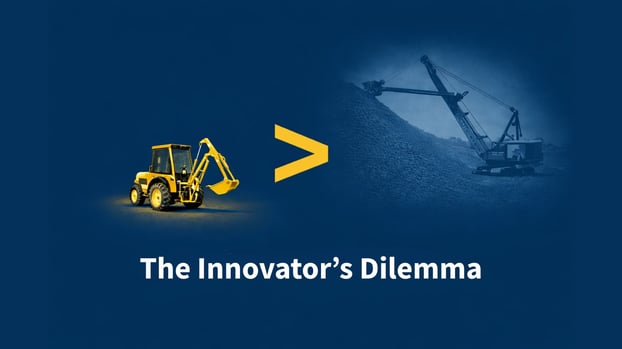
Of roughly 30 major excavator manufacturers, all but 4 disappeared during that transition. The difference this time? Early hydraulic excavators were tiny. They couldn’t handle large jobs. They were relegated to digging small ditches on farms and residential sites, not the “real work” of digging mines and canals. Compared to the machines incumbents sold to their customers, the hydraulic machines looked like toys.
Toys the incumbents could safely ignore. They focused on their customers, while hydraulics worked on the sidelines. Slowly, the toys improved quietly in the ditches, and by the time the incumbents realized that hydraulic machines were capable of handling large jobs, it was too late. These toys pushed them out of their core business into specialty machines, where they went to die a slow death.
This is the Innovator’s Dilemma as defined by Clay Christensen. Tech services founders shouldn’t worry about AI because it is so powerful. They should worry about AI because it is so bad, riddled with errors, hallucinating issues, and making generic statements. AI is not a sustaining improvement solved by a new IDE, or small customization to a cold email. It’s a disruptive innovation that changes how tech services businesses are built, and the winners and losers will be defined by how they deal with hours.
Hourly Consulting Meets the Innovator’s Dilemma
Christensen distinguishes between sustaining and disruptive innovation. Sustaining innovations improve performance along dimensions incumbents already value. Disruptive innovations initially look worse by those same measures before redefining what matters. AI is disruptive to consulting in exactly this way.
Inside an hourly model, AI-driven efficiency doesn't show up as progress — it shows up as lost revenue. Work gets faster, fewer hours are billed, and margins compress. Utilization becomes harder to forecast, while costs — especially senior talent and overhead — don’t fall at the same pace. What looks like technological improvement creates economic friction.
This puts consulting firms in a no-man’s land. The old model no longer works, but abandoning it feels dangerous because pricing, planning, and compensation are all built around hours. Founders try to protect the business by holding rates or reshaping scopes, but those are defensive moves. Over time, value creation and value capture drift further apart, and the business slowly erodes without a clear path forward.
The Problem of Hours
The biggest weakness of consulting firms is the belief that they are delivering hours. Even firms that sell fixed-price contracts still organize the business around time. Pricing, planning, compensation, and assessments of business health all trace back to hours delivered.
As long as this remains true, efficiency will always look like revenue loss. Long timelines are tolerated because they preserve utilization. Speed creates anxiety because it reduces contract size. And the moment utilization drops, alarms start ringing regardless of the company’s gross margins.
Yes, This Applies Even If You’re “Doing AI”
Almost all consulting firms today are adopting AI. Claude is writing their code. ChatGPT is drafting their blog posts. Clay is customizing their outbound. On the surface, it looks like real change.
But if you look closely, most of this is sustaining innovation. We’re parceling off discrete pieces of work and letting AI help complete them faster. Productivity improves. Delivery speeds up. The underlying business model stays intact. Because these changes fit neatly inside an hourly framework, they feel safe. And they create the impression that the firm is embracing AI.
That sense of safety is the danger.
The real threat has never come from sustaining innovation. It comes from disruptive innovation, the kind that doesn’t fit the existing model at all.
AI-First Consulting: Embracing the Disruption
Disruptive innovation requires starting with AI, quirks and all. Not as an assistant, but as the default. Every customer interaction assumes AI is present. Every engagement begins with a base AI-powered platform. The organization operates platform-first, not people-first.
In this model, consultants stop being the primary unit of delivery. They act more like forward-deployed engineers: integrating, customizing, and feeding learning back into shared IP. Value is delivered through a combination of proprietary systems and human judgment, not hours logged.
Hourly pricing makes this transition nearly impossible. Platforms reduce billable effort before they create leverage. Inside an hour-based P&L, that shows up immediately as revenue loss. So firms rationalize. They convince themselves their consulting is meaningfully better, more bespoke, more "premium", even as customers increasingly compare outcomes, speed, and price to product companies.
We’ve seen this pattern before. DEC, Kodak, Nokia, Blockbuster all recognized the shift early and struggled to act because it threatened the economics of their core business. A more recent example is Intel. Intel understood that compute was fragmenting. It had technologies that could compete with ARM and NVIDIA. But aggressively pursuing those paths risked cannibalizing the margins of Xeon, the business that mattered most. Acting too early would have destroyed the present.
Hourly consulting creates the same trap. AI-first delivery lowers ticket size before it builds leverage. Firms that use hours as a crutch protect near-term revenue while customer success and business success slowly diverge. And by the time the gap is undeniable, the organization has already optimized itself into irrelevance.
Seeing the Shift Before It’s Obvious
The Innovator’s Dilemma never announces itself loudly. It shows up as reasonable decisions that feel safe in the moment. Incumbents don’t lose because they ignore new technology. They lose because they keep optimizing the model the technology is quietly making obsolete.
AI-first consulting isn’t theoretical anymore. Founders are already experimenting with platform-first delivery, outcome-based models, and IP-driven leverage — often in ways that don’t show up cleanly in today’s revenue metrics. This shift is happening unevenly, and quietly, at the edges of the market.
If you want to see what this transition looks like in practice, meet the founders already wrestling with these tradeoffs and learning what actually works. We’re bringing those conversations together at VixulCon on April 20th. It’s not about AI tools or hype. It’s about how tech services companies are being rebuilt when hours stop being the center of the business.