We’ve been talking about partnerships at Vixul, but how partnerships work is being disrupted right now. It’s not the same Silicon Valley. Previously, tech giants focused on high-margin software products. But the big tech playbook is changing.
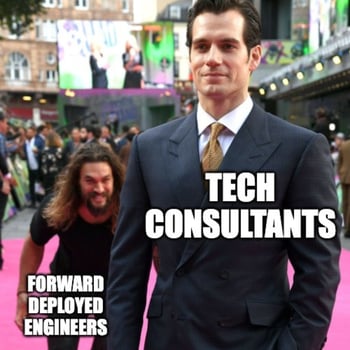
If you look closely, you’ll see this changing reality in a role that is popping up in startup hiring: Forward Deployed Engineers (FDEs). Popularized by companies like Palantir, this new role represents a major shift in how big tech operates and builds partnerships.
Wait, what’s a Forward Deployed Engineer?
If you’re wondering what FDEs are, this video from Y Combinator is a great starting point. Being at the forefront of emerging technologies is one of the most lucrative positions a tech services company can take. That's where you get to define the usage of the technology and create paradigms that establish you as an expert. But FDEs do that too, from within the big tech platform.
At a high level, Forward Deployed Engineers combine three responsibilities that are often split across different teams or even different companies:
- Implementation Engineer
- Solution Architect
- Product Feedback Loop
Individually, none of these responsibilities are new. What’s new is that they are now intentionally unified inside product companies.
Implementation Engineer: Where Reality Meets the Product
This is the most familiar responsibility. Implementation engineers are responsible for making the product work in the real world. In enterprise environments, that almost always means integrating with existing systems, data pipelines, security controls, and operational workflows.
This is why consultants are so often called system integrators. Products are, by necessity, well-defined and opinionated. Customers are not. Every enterprise deployment introduces edge cases, exceptions, and constraints that no product team can fully anticipate.
Consultants come in and implement integrations to enable customers to use the product. Forward Deployed Engineers bring that responsibility back closer to the platform provider.
Solution Architect: Selling Outcomes, Not Features
Solution architects sit at the intersection of business problems and technical capability. They understand the customer’s goals, design the architecture, and help close the deal.
But the best solution architects do more than enable sales. They understand how the product can evolve inside the customer’s organization, anticipate future use cases, and shape roadmaps at the account level.
With this knowledge, Solution Architects control the adoption of a product over time. This makes the role extremely important to product companies.
Product Feedback: The Missing Link
Every business claims to be customer-centric. Few truly are.
The people who actually understand customers are the engineers and architects who are embedded in real-world deployments. They’ve got their eye on what breaks, what slows teams down, and where products fall short. System integrators naturally have more access to the daily pain points of customers than product companies. Or did, until FDEs emerged.
The beauty of Palantir’s approach, and the broader Forward Deployed Engineer model, is that it brings this understanding of customer needs in-house. FDEs work alongside Forward Deployed Strategists, whose job is to translate field-level insight directly into product strategy. Ad hoc implementations become patterns. Patterns become features. Features become platform capabilities. And product design is continuously realigned with the needs of the customer in a tight feedback loop.
Why are FDEs Redefining Consulting?
There are two major reasons underpinning why FDEs are a major shift for consulting. The first is that every successful company wants to close the customer-product feedback loop. The second is that AI has changed the equation on customization. Both in terms of the cost of customization and the need for customization, AI is driving product companies to bring more of the consulting capabilities in-house.
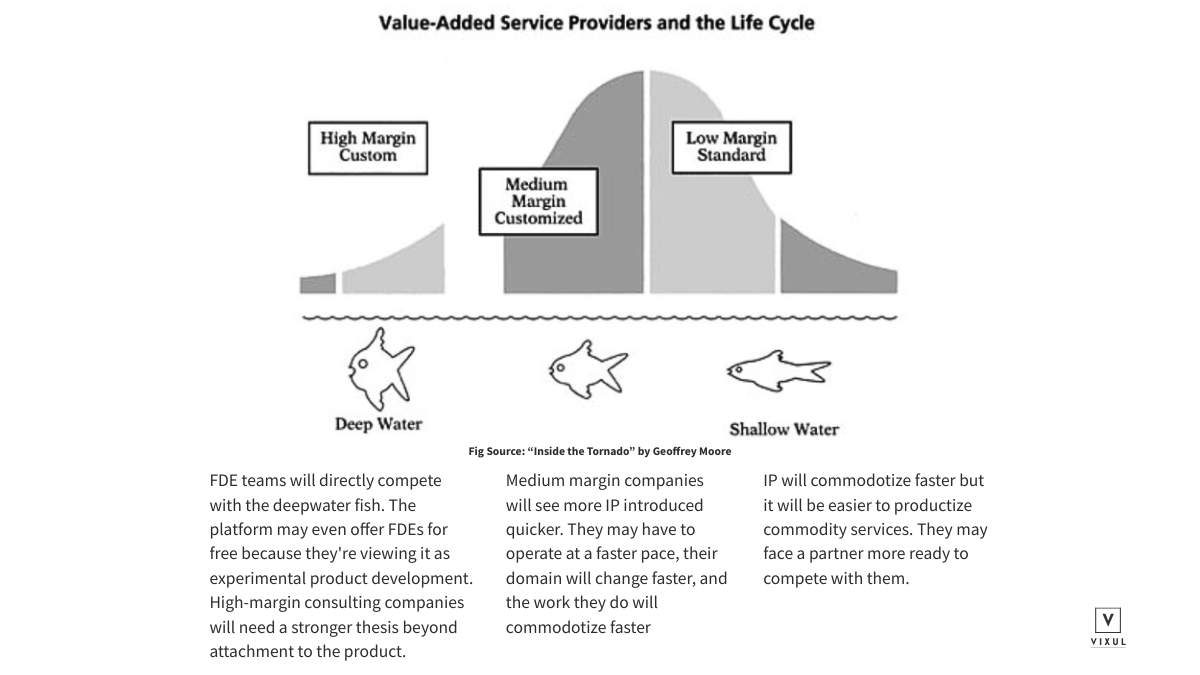
FDEs will encroach on the work done by deepwater tech services (to borrow a term from Geoffrey Moore’s “Inside The Tornado”), creating tension between the role and tech services companies. As shown in the image below, emerging tech services companies (the "deepwater fish" in the software lifecycle), which typically enjoyed the highest margins for delivering custom solutions, will experience direct competition from FDEs. This doesn't mean medium-margin and low-margin companies (the "shallow water fish") won't be impacted. They'll be pressed to work at a faster pace, and the shallow-water fish may face a partner more ready to compete with them.
Wrapping Up
FDEs represent a structural shift in how big tech engages with customers and partners. By unifying implementation, architecture, and product feedback inside the platform, product companies are reclaiming work once owned by services firms. This will change our understanding of tech services as an industry, and what comes under tech consulting.
So is it all over for founders of tech services companies? Not at all. We believe this is a continuation of an ongoing trend of the distinction between products and services degrading. It does mean the playbook for a modern services company will be different. Firms that adapt successfully will thrive, moving upstream into differentiated positioning, using IP and domain expertise to bring a holistic experience the platforms cannot cater to.
📣Join Us at VixulCon 2026
You will be seeing a lot more from us on what a services company needs to look like in the age of AI. In fact, this year’s VixulCon is themed “Customization At Scale: AI’s Impact On Tech Services” to envision this future. Find out more about VixulCon 2026 here.