In our last blog post we asserted Forward Deployed Engineers (FDEs) represent a disruption to tech consultancies. We see this as one of the early effects in how AI is going to change the world of tech startups. This is a culmination of a trend we've observed over the past few decades in how the distinction between service and product companies has been eroding and now with AI we should we prepared to rethink how both service and product companies will operate going forward.
To understand why this shift matters, we must first revisit the old economic contract between products and services.
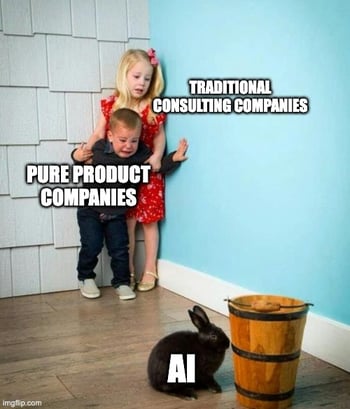
The Old Contract Between Product and Services
For decades, the division between product companies and consulting firms was clear and efficient.
Product Companies
They encoded a narrow set of assumptions about how work should be done. That specificity was a feature, not a limitation. It made software easier to build, sell, support, and scale. The more opinionated the product, the more repeatable it became. By focusing on their one piece, product companies:
- Kept the highly reusable and consequently the highest gross margin work
- Relied on an ecosystem of product and services partners to complete the solution for the customer
The dominance of a product is defined by a “less is more” ethos, with the best ecosystem to provide a complete experience and a moat against competitors.
Consulting Companies
Real customers rarely matched the clean workflows imagined by product teams. The gap between the messy reality of customer's workflows and the standardized product was filled by consultants. The consultants focused on
- The consultants' work was bespoke, so it was more expensive but had a lower gross margin.
- Significantly reduced risk to success because you build IP on request.
- The consultants maintain strong relationships with both parties.
The success of the consultant was based on building a relationship and using available technology to solve the customer's problem.
The Contract
This reality created a partnership. The tech company built the solution. And the consultants hired people to integrate the solution into customer environments. But there were some cracks and always an underlying tension.
AI has turned these cracks into fissures.
AI Breaks the Assumption That Products Can Be Fully Standardized
AI disrupts the assumptions that kept this model stable.
Traditional software behaves predictably. Given the same inputs, it produces the same outputs. That predictability made it possible to draw a hard line between standardized product functionality and bespoke customization.
AI systems don’t behave that way. AI output depends on:
- The data used to train the AI
- The context and user interactions leading to the query
The working of the product is so closely tied to the specific usage by the customer that it is nearly impossible to separate the product from the consulting. We talked about how the FDEs at Palantir and It’s not a coincidence that Palantir is an AI company. To unlock the value of AI you need more customization.
At the Same Time, AI Makes Customization Scalable
While AI increases the need for customization, it also dramatically reduces the cost of customization. AI is bringing down costs for designing, developing, testing, integrating, and aligning with sales and marketing. AI requires more customization to work. AI may require more customization to work, but it also unlocks the ability to deliver that customization at scale.
This changes the gross margin equation that made the product companies avoid services and integration. The question is no longer what belongs in the product vs what should be in consulting. It is how can we use AI to maintain high gross margins in customized solutions to solve the customer problem.
What This Means for Consulting Firms
This shift may seem like an existential threat to consulting firms. Product companies are pulling implementation, architecture, and feedback loops closer to the core and using their deep pockets to push out consultants.
But the actual shift that is happening is far more subtle and it will change the world of both product and services.
Technology has long been sold as technology first and a solution to a problem second. While companies that focused on solving the customer problem have always been more successful, this moment represents a change. At Vixul, we have long made a distinction between traditional bodyshop consulting companies and differentiated tech services companies. AI is going to make this distinction into a necessity.
Every company will need to focus on delivering value and providing a clear elucidation of that value. Product IP will be equally important both for customer-facing IP and team-enabling IP that allows your on-the-ground implementers to work more effectively. The biggest difference in direction will come from the focus. The traditional product companies with their investment directives for for TAM size will need to expand quickly and generalize while the modern services companies will need to focus on narrowing their scope to enable them to dominate their respective areas. Both of them will have a significant amount of product and services to help them in their goals. But the biggest difference is in the scope they will focus on.
Vixul is preparing for this disruption. We have always had a focus on narrowing scope. But we are redesigning the Vixul, program to cover the full journey. And for this year’s VixulCon we are exploring the consulting company of the future with our theme of: “Customization at Scale: AI's Impact On Tech Services”.
Please register here to join us for VixulCon 2026.