Product companies are hiring consultants. Customers are building solutions themselves. Engagements are compressing from years to months. AI poses an existential threat to traditional tech services firms.
At the same time, customization is exploding. New problems are suddenly worth writing software for. Expertise can now be codified and deployed at scale. AI poses a historic opportunity for tech services firms.
In 2026, the firms that thrive won’t just use AI — they will be built differently because of it.
The cost of building software has collapsed, making custom solutions economically viable at a scale we haven’t seen before.
Before projecting forward, we need to understand the starting point. The economics inside tech services firms are shifting just as the competitive landscape and customer expectations outside them are evolving. A straightforward SWOT makes those shifts explicit.
A Services Firm in an AI World: SWOT
| Strengths |
Weaknesses |
|
|
| Opportunities |
Threats |
|
|
The strengths are real: services firms are trusted and built to customize. But their weaknesses sit directly in the path of the threat. When revenue depends on labor and knowledge lives in individuals, AI-driven efficiency doesn’t compound — it compresses. At the same time, the cost of building software has collapsed, making custom solutions economically viable at a scale we haven’t seen before. That creates more opportunity for services firms — and lowers the barrier for product companies to move directly into their territory.
If those pressures are structural, the response must be structural.
1. From Broad Capability to Vertical Depth
While we have always advocated for sharp positioning (see our whitepaper), AI has made vertical focus a necessity. When software is cheaper to build and output is easier to generate, generalized capability becomes comparable — and quickly commoditized. The only durable edge is depth: industry context, repeatable workflows, and economic insight. Even a strong horizontal focus offers less protection now, because AI dramatically lowers the cost of acquiring high-demand capabilities.
Trusted customer relationships give services firms direct access to real operational friction. Product companies, constrained by venture-scale TAM expectations, cannot afford to hyperspecialize within a single vertical to the same extent. Services firms can — and that narrow depth is what allows advantage to compound.
Firms must anchor pricing and positioning around the value their systems and expertise create, not the hours required to deliver it.
But focus alone is not enough. Depth only becomes advantage when it compounds.
2. From Projects to Platforms
Vertical depth creates repeatability. Repeatability creates the opportunity to build systems. Without that shift, even a focused firm remains a collection of projects rather than a compounding organization.
Traditional services firms treat each engagement as a discrete delivery cycle. Knowledge improves the team, but rarely the firm. Each new project starts closer to zero than it should.
AI changes the economics of building capability. When software is dramatically cheaper to build, codifying workflows, internal tools, and automation layers becomes operational discipline, not long-term R&D. Every engagement can strengthen shared infrastructure.
Owning that infrastructure matters. Proprietary IP insulates you from price pressure because you’re deploying a system, not just labor. It also creates a path beyond pure hourly billing, allowing pricing to reflect leverage and outcomes rather than time.
Once delivery becomes system-driven, what you sell must change as well.
3. From Delivering Labor to Delivering Value
Traditional services firms sell time. Revenue expands as billable hours expand. Growth follows headcount.
AI weakens that model. When software is cheaper to build and systems absorb repeatable work, customers increasingly evaluate outcomes, speed, and impact — not effort. If you price and position around labor, efficiency works against you (as we explored in Hours and the Innovator’s Dilemma).
The rebuild requires shifting what is being sold. Firms must anchor pricing and positioning around the value their systems and expertise create, not the hours required to deliver it. When internal platforms compound and workflows improve, value can increase even as effort declines.
And once value replaces labor as the anchor, the client relationship itself evolves.
4. From Vendor to Embedded Partner
Deep customer relationships are already a core strength of services firms. Embedded access creates understanding — not just of stated requirements, but of operational friction and emerging opportunity.
Product companies recognize this. As we explored in This Job Role Is Quietly Disrupting Tech Consultancies, they are adding consulting layers to move closer to the customer. Proximity drives insight.
AI changes customer expectations. When the cost of building custom software collapses, the question shifts from “Can we afford to solve this?” to “Why aren’t we solving more?” Most customers don’t yet see the expanded surface area of economically viable problems. They need partners who can identify and prioritize opportunities before they are formally requested.
This is what AI-first consulting actually means — not using AI in delivery, but building the firm around it.
By 2026, the most valuable services firms won’t just execute defined projects. They will continuously surface new value inside client environments — turning proximity into a compounding growth engine.
The Structural Divide
In 2026, tech services firms will fall into two camps. One group will adopt AI tools but preserve their old structure — broad positioning, project-based delivery, labor-driven revenue. They will feel secure for the time being but will find their business under increasing pressures.
The other group will rebuild. They will narrow their focus, codify knowledge into platforms, price around value, and embed deeply with customers to surface new opportunities. This is what AI-first consulting actually means — not using AI in delivery, but building the firm around it. Their systems will compound.
The difference won’t be intelligence or effort. It will be design.
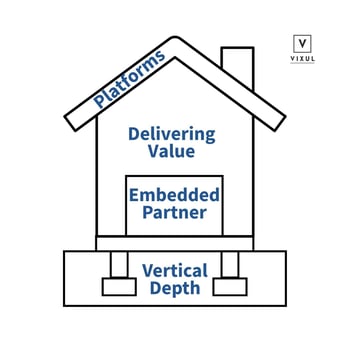 The rebuild isn’t theoretical. Firms are already experimenting with vertical depth, internal platforms, value-based pricing, and embedded collaboration. AI-first consulting isn’t about tools — it’s about firm design. And that design is still being defined.
At VixulCon, we’re bringing together some of the most innovative minds in tech services to wrestle with exactly this question: what does it actually mean to build an AI-first consultancy — and what are the hard challenges in getting there? If you want to help shape what 2026 looks like, join us.