In the previous blog post, we talked about the importance of incorporating Business Model Canvas for aspiring tech services entrepreneurs, and in this one, we shall delve deeper by discussing how it varies for Traditional Tech Services (TTS) firms compared to Emerging Tech Services (ETS) ones. At the end of this blog, we have created a free template for BMC and samples for it
Questions to Ask Before Creating a BMC for ETS Firms
As a tech entrepreneur, you need to address five key points before laying the groundwork for your Business Model Canvas. You can find out more about this by watching our webinar video on our YouTube channel, but for now, we will discuss in more detail how tech service firm entrepreneurs use positioning to their advantage.
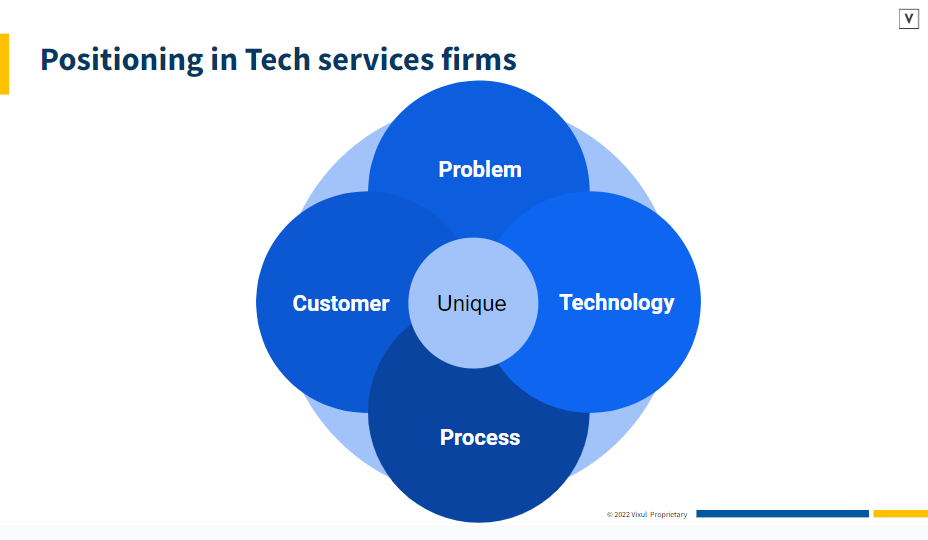
Problem
- Is the problem stated in a way that is specific to the target customer and will resonate?
- What is the problem you are trying to solve?
- What happens if this problem is not solved?
- What is the business value you provide? (Unlock revenue, reduce time to market, reduce costs, reduce risks, improve customer experience)
Customer
- Who is the customer?
- If you build a target customer list, will it have 1,000-10,000 customers?
Technology
- What is the technology you want to be known for?
- What tech platforms are dominant in this technology?
- What are 80% of the supplementary technologies you'll work on to deliver value to the customer?
- How does this technology deliver the value you are targeting?
- Are you going to be devoted to a single platform?
Are most listed technologies growing at rates similar to your growth target?
Process
- Does the process answer the question: how do we get started, and what's after that?
Unique
- Is it a testable claim that is also relevant to your customer?
Elements in a Business Model Canvas
A Business Model Canvas (BMC) has 9 main sections but can be tweaked according to the needs of your own firm.
These sections include Key Partnerships, Key Activities, Key Resources, Value Proposition, Customer Relationships, Distribution Channels, Customer Segments, Cost Structure, and Revenue Streams. We will go over each section briefly.
1) Key Partnerships
Description:
The relationships with suppliers, manufacturers, vendors, customers and other stakeholders an organization must maintain to achieve their business goals.
Purpose:
This targets optimizing processes, reducing the risks of uncertainties and maintaining a directory of where to obtain essential business resources and activities.
Types:
There are two types of partnerships to be considered,
> Subcontractors:
They are hired by contractors to handle specific tasks in larger projects. They help manage overflow, reduce costs. Subcontractors can either be individuals or companies and act as outside consultants to keep projects on track during busy periods and tighter deadlines.
> Strategic Business Relationships:
They involve partnerships between service firms and product providers. The service firms use the provider's technology or products in exchange for benefits like referrals or discounts. This allows the firm to expand offerings, increase visibility, and reduce risk without needing to develop or acquire new technology. In this scenario, the PSF acts as a Managed Service Provider or VAR.
2) Key Activities
Description:
The steps an organization must take in order to achieve its identified value proposition.
Purpose:
Key activities are planned by the organization and can be updated as goals evolve or shift. These activities are crucial to how the business operates and require continuous feedback and research to ensure smooth operations. Areas such as product manufacturing, service distribution, marketing, sales, customer relationships, and networking are all addressed under key activities.
3) Key Resources
Description:
The assets that an organization requires to perform its key activities.
Purpose:
Identified key resources are those which help achieve the tasks involved in key activities. These include human, financial, physical and intellectual (patents, copyrights, etc.) resources. Time-saving processes and tools such as methodologies, SOPs, technology, and procedures are also included.
4) Value Propositions
Description:
An organization's unique offering of products/services in the tech market and proposals as to why it will be successful.
Purpose:
To succeed, tech businesses must deliver unique value through performance, design, or specialization. Since differentiation is crucial, standing out with a clear, evidence-backed promise helps build a strong identity in a competitive market. This organization-specific specialization should also be incorporated within marketing efforts to improve brand identity. Regularly updating strategies based on client feedback and market research is also important to keep things streamlined.
5) Customer Relationships
Description:
How an organization interacts with its target customers and maintains relationships with them.
Purpose:
For tech firms, it is important to navigate their relationship-building strategies and leverage off of their contracts for long-term established bonds based on trust and delivery of promised products/services. Face-to-face contracts, referrals, attending social events for networking and marketing outreach all help in creating new customer connections.
6) Distribution Channels/Channels
Description:
They act as the link between the organization and its consumers. The target audience can be reached through the marketing and distribution of the products or services being offered.
Purpose:
Invest in a more capable website. Your website often contributes to a prospect’s critical first impression of your firm. If you aren’t proud of the image it portrays, or if your site doesn’t clearly explain who you serve and what you do, you are handicapping business development.
7) Customer Segments
Description:
The types of people or businesses that are interested in acquiring a company’s products or services.
Purpose:
Understanding your target audience allows you to focus your business narrative effectively. It's crucial to target industries with strong growth potential for traditional and emerging tech industries alike. Regularly researching your clients, especially your key audience, helps you understand their needs and preferences better, even after there is a shift within a market. By adjusting your approach based on this research and feedback loop, you can grow faster and increase profitability. For ETS firms the OODA loop can be implemented for customer preferences and not just emerging technologies.
8) Cost Structure
Description:
The major drivers of organizational expenses, or total cost, that need to be tracked and managed are those that contribute to achieving the identified value propositions.
Purpose:
The organization’s cost structure depends on the type of products or services provided, which can be either value-driven or cost-driven. Costs can be fixed (e.g., salaries, rent) or variable (e.g., one-time or recurring expenses). For service firms, key performance indicators (KPIs) are useful in tracking the costs associated with running the business.
9) Revenue Streams
Description:
The ways in which an organization aqcuires money.
Purpose:
This involves analyzing the current strategies the tech organization is using to procure subscriptions, generate sales, and more. The discussion also touches on the pricing of products or services, including what the customer base is willing to pay, whether through fixed or dynamic pricing models.
For more of a detailed read, refer to useful resources online, such as ones written by authors Patrick, Tim, Alexander, and on the website durichitayat.net.
The main concerns for traditional tech firms and emerging tech services firms may be different and much more specific, which is going to be discussed below.
Business Model Canvas for Traditional Tech Service Firms
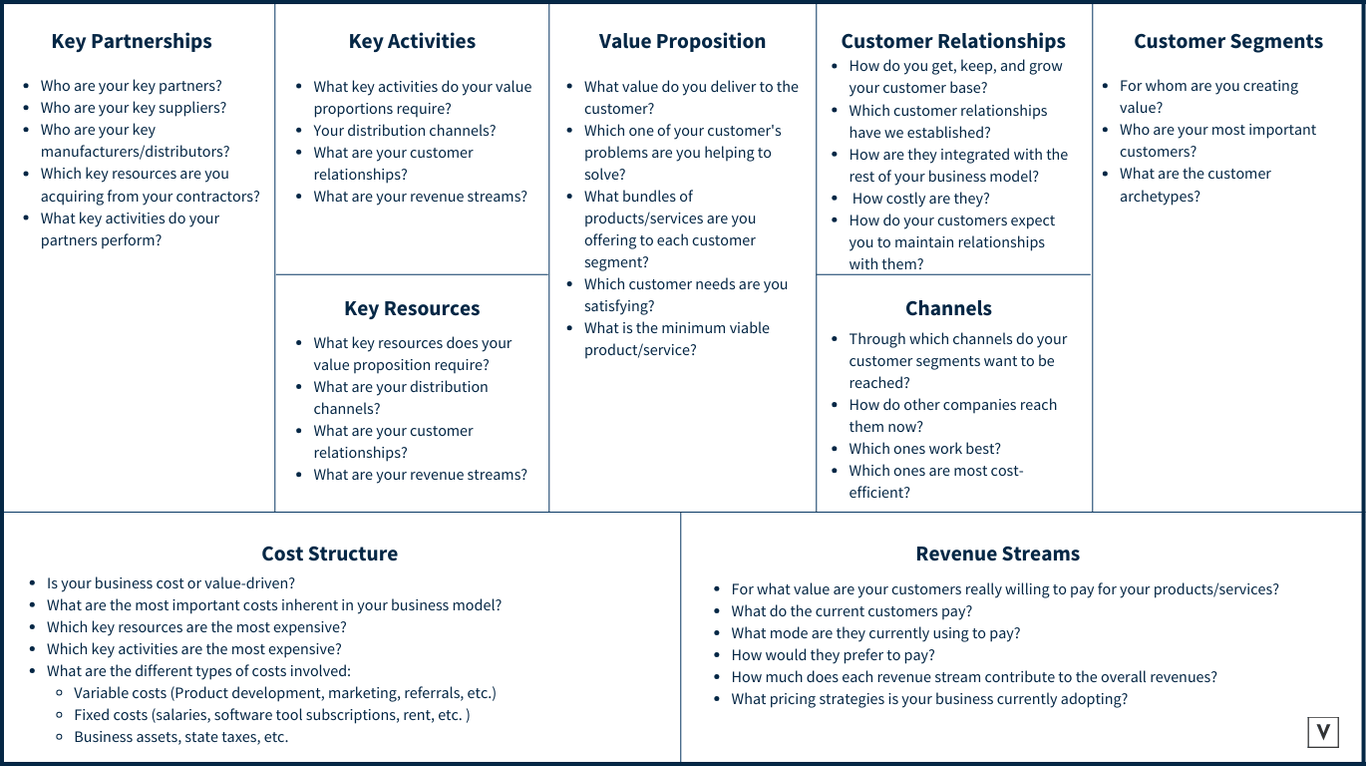
These are the questions TTS firm entrepreneurs ask as they build a BMC for their business.
Key Partners
- Who are your key partners?
- Who are your key suppliers?
- Who are your key manufacturers/distributors?
- Which key resources are you acquiring from your contractors?
- What key activities do your partners perform?
Key Activities
- What key activities do your value proportions require?
- Your distribution channels?
- What are your customer relationships?
- What are your revenue streams?
Key Resources
- What key resources does your value proposition require?
- What are your distribution channels?
- What are your customer relationships?
- What are your revenue streams?
Value Proposition
- What value do you deliver to the customer?
- Which one of your customer's problems are you helping to solve?
- What bundles of products/services are you offering to each customer segment?
- Which customer needs are you satisfying?
- What is the minimum viable product/service?
Customer Relationships
- How do you get, keep, and grow your customer base?
- Which customer relationships have we established?
- How are they integrated with the rest of your business model?
- How costly are they?
- How do your customers expect you to maintain relationships with them?
Channels
- Through which channels do your customer segments want to be reached?
- How do other companies reach them now?
- Which ones work best?
- Which ones are most cost-efficient?
Customer Segments
- For whom are you creating value?
- Who are your most important customers?
- What are the customer archetypes?
Cost Structure
- Is your business cost or value-driven?
- What are the most important costs inherent in your business model?
- Which key resources are the most expensive?
- Which key activities are the most expensive?
- What are the different types of costs involved:
- Variable costs (Product development, marketing, referrals, etc.)
- Fixed costs (salaries, software tool subscriptions, rent, etc. )
- Business assets, state taxes, etc.
Revenue Streams
- For what value are your customers really willing to pay for your products/services?
- What do the current customers pay?
- What mode are they currently using to pay?
- How would they prefer to pay?
- How much does each revenue stream contribute to the overall revenues?
- What pricing strategies is your business currently adopting?
Business Model Canvas for Emerging Tech Service Firms
Here's what you should be asking as an emerging tech services firm entrepreneur while you're creating your very own BMC.
Key Partners
- Which tech platform will be the key partner you will align the business to?
- What other platforms do you need to understand and require partnerships to address the problems you are trying to solve?
- Are you going to enter into any subcontracting agreements with GSIs?
- Who do you trust to be your subcontracting partner for flex capacity?
Key Activities
- Thought leadership on the chosen focus
- Partner relationships
- Sales and marketing
- Project delivery
- Customer support
Key Resources
- Talented engineering team and training assets.
- Project management processes and team
- IP accelerators
- Monitoring tools
- Playbooks
- Reference architectures
Value Proposition
- What is the problem that you are solving for your customers?
- What is the business value delivered to the customer out of:
- unlocked revenue
- reduce time to market
- reduce costs
- reduce risks
- improve customer experience
- What are your service offerings?
- How do your service offerings solve this problem?
Customer Relationships
- How are you building general brand recognition and establishing thought leadership?
- How are you building a relationship with your key tech platform partner?
- How are you proving competence to your customer’s engineering teams?
- How are you proving relevance to your customer’s executive team?
- How are you expanding your relationships with your customer teams?
Channels
- Thought leadership content is a must to establish your credibility.
- Is there a tech platform you can partner up with because you are making your customers successful?
- What are your focused social media platforms?
- Can you spend 2000 a month on ads?
- What is my cold outreach strategy?
Customer Segments
- For whom are you creating value?
- What group within your customer organization is the biggest stakeholder?
- Do your customers belong to a particular vertical?
- What is the size of customer you are positioned to serve now
- Who do you want to serve in the future?
Cost Structure
- HR costs are the bulk of the costs, with a breakdown of roughly:
- 40-50% COGS
- 10-15% operations (High growth might bump HR costs)
- 20-40% on sales and marketing
- <10% other (software, tools, facilities)
Revenue Streams
- Every tech services company needs the three revenue streams listed below, but the percentage of each stream is specific to the company:
- Architecture and design
- Project implementation
- Support and management
Conclusion
Utilizing the Business Model Canvas is a powerful step for aspiring tech entrepreneurs looking to navigate the complexities of building a successful business. By reflecting on the essential questions outlined throughout this post, you can clarify your value proposition, identify key activities, and understand your cost structure model.
Don’t wait to take your first step—create your own BMC today! Sign up to receive our template and sample directly in your email. Your entrepreneurial journey begins now!