I was wrong.
At Flux7 we spent a million dollars on our software and tooling. It was a significant investment and the return was lower than we would have gotten from more conventional sales tactics. At Vixul we were concerned about founders being led too much by engineering creativity, and we discouraged them from over-investing in platform capability and IP. What we did not imagine in 2022 is how drastically AI would change the world.
Now, with what AI has done to development, we have not only reversed course, we see building AI-native systems as the highest ROI work your business can do. In fact I would argue this list of five places to invest in AI either supersedes our 2024 list on where to invest, or becomes a prerequisite to it.
1. AI-First RevOps
There has been growing pressure on revenue teams to not behave in silos. The creation of the CRO role, RevOps. More automation and better data management. AI has changed the equation. We are entering a new era of collecting, collating, and acting on data.
An example of what is possible in this new world is Vixul portfolio company Bitsol Technologies. With AI integration across the board, Bitsol is able to use their data for creating highly targeted campaigns. At a recent conference with prospecting and targeted cross-channel outreach they were able to set up 12 prospect meetings without any BD involvement.
An AI-First RevOps engine has more complete data, better maintenance of the data, and drives activities and decisions with this data. The result is a lower cost of sale on every deal you win.
2. AI-Customized and Expedited Sales
We've always had a motto with sales, "time kills deals." AI has rewritten what is expected of sales. AI allows you to have better insights on the customer, building a more intimate relationship and giving you a deeper understanding of their problem. You use this to present a higher quality solution quickly, to demonstrate you are devoted to quickly fixing their problem.
Our portfolio company Brainforge has built a system for this. In the words of Brainforge CEO Uttam Kumaran, "I want every lead to feel like they're the only people we're talking to." AI-powered pre-qualification, every seller enters the meeting room with a deep understanding of the customer's problem and their AI-powered SoW generation lets them turn around the final SoW in 2 days.
Time kills deals, but so does a generic proposal. Every campaign and every SoW is read by a human before it goes out, so what arrives faster also arrives better, and it costs you less selling time to get there.
3. AI-Transformed Delivery Team
Your internal tools never got past glorified spreadsheets. Every engineer-week hardening one was a week not billed. Building is cheap now, so the scarce thing is curation. The Working Town has run forty-plus SAP integrations in eighteen months and turned the connective tissue into a reusable layer. A typical enterprise SAP deployment carries three thousand custom objects, so nothing generic survives it. But it is all customizable, and that is where AI excels. With the cost of building and managing software going down, well-curated tooling to help you deliver higher quality outcomes is now feasible and required. Every asset you harden takes cost out of your COGS and puts quality back in.
If your delivery team is not AI-first, then you are underperforming for your client.
4. AI-First Talent Ramp
The biggest limiter in growing your services business was how quickly you could have customer-ready engineers. Solid processes with managers trained in enforcing the systems were a huge part of what made a services company successful and constituted a large part of the IP of the business.
This IP no longer looks like what it used to. Umair Shahid demonstrated that at Stormatics, which hit the wall standing up 24/7 Postgres coverage. His diagnosis: "I need senior people and senior people are expensive people." He wrote the SOPs first, then built an agent trained only on those SOPs and his own documentation, so apprentices working off-hours had a fallback. Four people now manage a few hundred production databases. Fund the ramp material, internal tooling, and SOPs. It buys gross margin and growth without proportional hiring.
Most of the world has it inverted. They're thinking junior engineers can't add value and seniors are more valuable than ever. But the best services companies are investing in IP to have juniors perform at the level of seniors. That is the largest COGS lever available to a services business.
5. AI-Enabled Managed Services
Building recurring revenue is essential for the long-term financial health of any tech services business. AI is enabling new models and capabilities to create recurring revenue options. Our portfolio company EZOps Cloud is a case in point. Their agent made engineers more productive, which cut billable hours, which made hourly self-defeating. They repackaged as a flat monthly AI-augmented engineer. Thiago Maior: "The convergence between software and services is no longer a future bet. It's already happening."
It's not just about guaranteed money. It is about the closer, more in-depth relationship. Your recurring revenue products will allow you to better understand your customer and drive their roadmap, creating a virtuous cycle. Knowing the roadmap is also how you price on the value you deliver instead of the hours you spend.
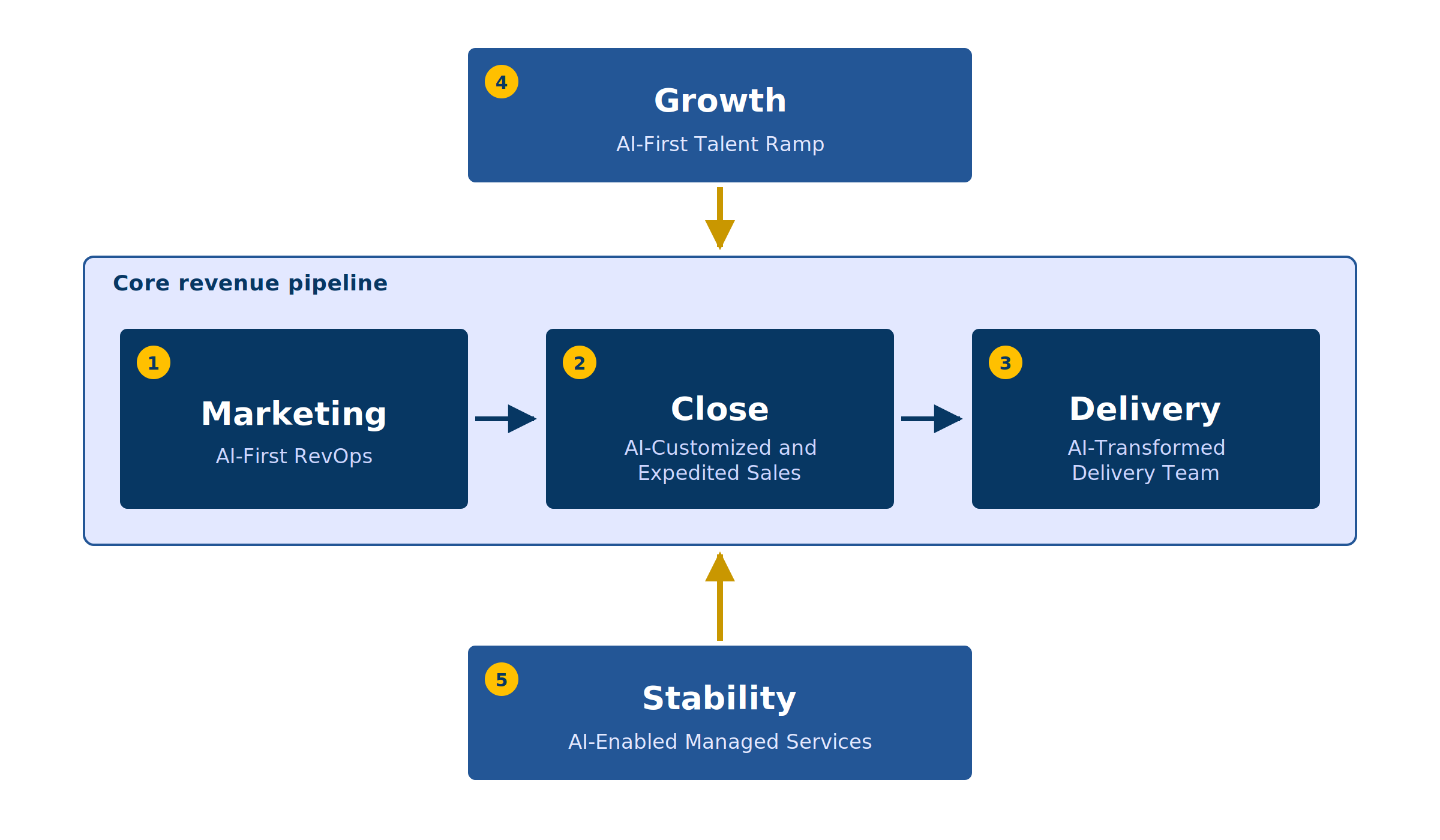
The five investments are not a menu. They are one value chain.
Closer than you could ever afford to be
The strength of a services business was never scale. It was the relationship. Software could not compete there, because design once and use many was the price of being software. AI removes the tradeoff, and the best firms are already using it to deliver customer intimacy at a depth nobody could previously afford. Every one of the five above cuts your cost of sale or your cost of delivery while raising what the work is worth to the customer.
That is not a soft benefit. It is pricing power. A firm that arrives already understanding the problem is not compared on rate, and that shows up as gross margin. This is what we mean when we tell founders: stop trading time, start building equity. The five places above are how you do it.
Our next public roundtable is September 24, Proof Over Promise, on how founders demonstrate outcomes for their customers. That is how AI investment turns into profit.