AI made your team ten times faster. Most founders are about to waste it. The instinct is to turn that speed on your own stack and rebuild everything you ever wanted to fix. That is the wrong target. Code was never the thing worth customizing.
AI-native services founders point that speed where it matters most. This article lays out three principles that have always decided when customization is right, and two places where it is a trap.
From tools to outcomes
Software products have always been tools. They provide a capability, not the outcome the client wanted. That gap was closed by integrating the client's business context and the way their business actually ran. Every business is unique. Its customers, its value, its marketing, its brand, its product. So this work was always essential, and it was never cheap. In our experience, for every dollar a client spent on a SaaS tool, six to twelve went to integration. Most work was simply too expensive to tailor. We have written before about the economics of AI-first consulting and rethinking the product-services divide.
AI changed the equation. Solutions that were once too expensive to build and maintain are now cheap to stand up, so teams reach deep into the backlog of valuable work that never justified the cost before. And the people doing the building changed. There was always a gap between the stakeholders who knew what they needed and the developers they waited on to build it. Now non-developers can build proof-of-concepts to demonstrate the need, and contribute to the code itself with the right guards in place. The ability to deliver outcomes improved sharply.
Competitive advantage through technology
Every thriving company in the 21st century was, under the hood, a technology company.
You see this in newcomers that create or disrupt business models, like Amazon, Google, and Netflix, and in traditional companies that lead their sectors, like John Deere, UPS, and Capital One. Customer experience, product R&D, financial prudence, every aspect of a modern business is built on superior use of technology to find insight and solve problems.
AI raised the stakes. There is now a rush to remake entire business units and how they meet customer needs. The productized solutions are not there yet. So everyone is forced into the custom development race, whether they planned to be or not. Off the shelf is not an option, which makes custom the price of entry. This is the shift behind why your tech services firm will be rebuilt or left behind, and why your clients are about to build what they used to hire you for.
Technology-defined workflows
For fifteen years technology did more than capture existing workflows. It redefined them. Cloud and DevOps did not digitize the old process. They built deeper workflows that were not possible before, with automated recovery and automated testing baked in.
AI has a profound impact in this category. Organizations are changing their org charts.
At Vixul, we always used to joke that AI was our third co-founder. Now we have formally incorporated AI agents on our org chart, taking responsibilities away from humans.
All across industry AI is rewriting workflows to be AI-driven with a human in the loop. Teams are building spec-driven development flows. Core business functions like CFO and CMO are being replaced with an AI CFO and AI CMO by startups. None of this comes off the shelf. Every one of these AI-driven structures is built for the business it runs, which makes the work custom by definition. This is the difference between AI that is bolted on versus what native unlocks.
Think twice before you customize
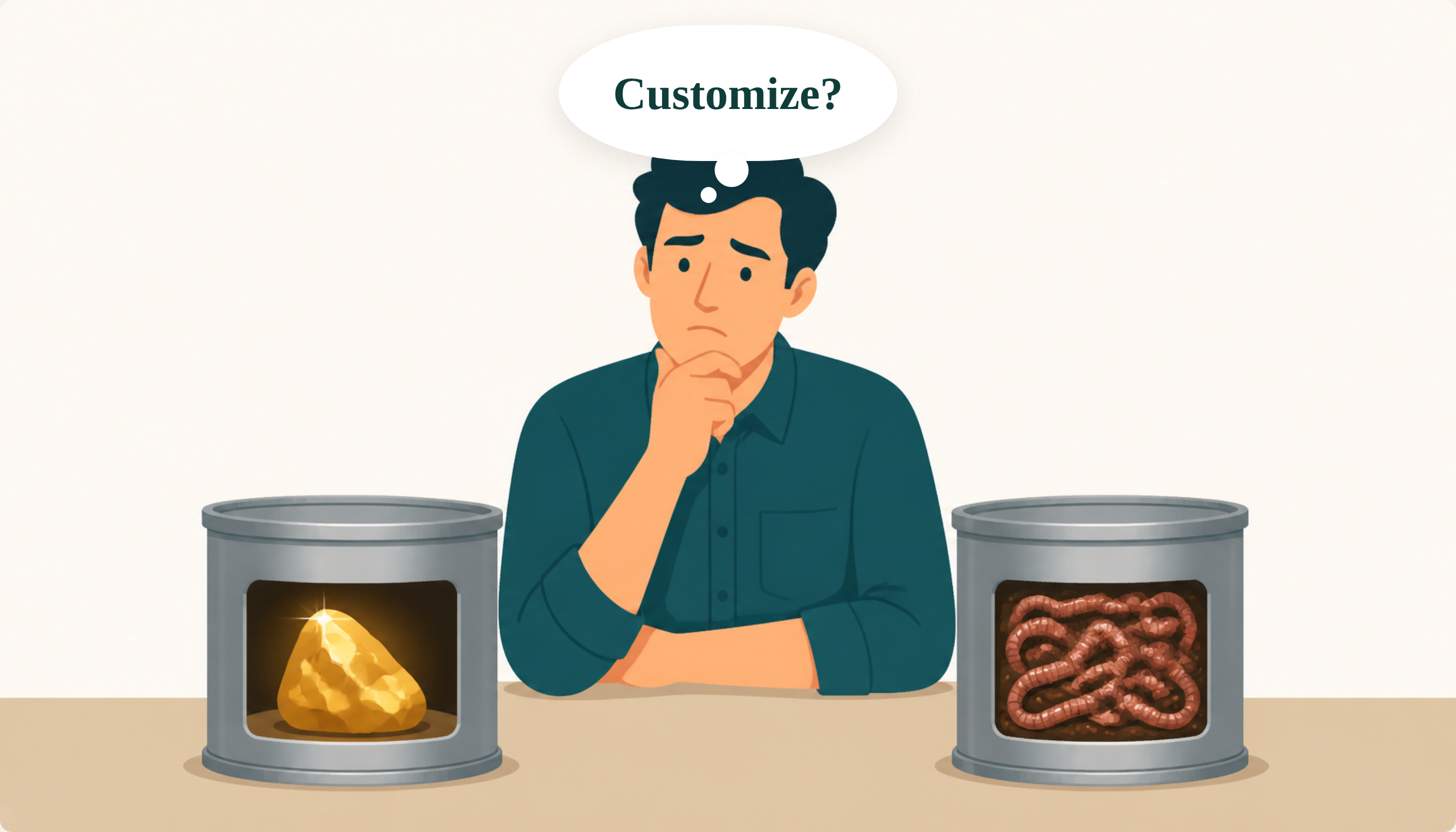
Not every layer rewards a custom build. The foundation is a building block by design. The database, the auth system, the payment rails, the deploy pipeline. These carry the learnings and the testing of millions of users before you. Customizing them opens a huge can of worms for little value. A custom version throws away that hard-won testing and asks you to rediscover every edge case the standard one already solved. Customers never see this layer. They only notice it when it breaks. Build on it. Do not rebuild it.
Be even more wary where governance and liability live. Compliance, audit, anything that decides who is accountable when something goes wrong. A custom build here is not an edge. It is exposure. The standard tools exist because someone already absorbed the cost of getting these wrong. Borrow that. The frontier is the customer experience, not the parts that put you in front of a regulator.
Where this leaves you
Three principles, unchanged for decades. Reach the outcome. Build the advantage. Redraw the workflow. AI did not invent any of them. It made all three affordable at once. The discipline is knowing the boundary. Customize what the customer feels. Stand on proven ground for everything they never see. That line decides where your speed is worth spending. In the end, you are not selling expertise, you are building a machine, and the machine is only as good as the judgment behind what you chose to build.